/ Sep 25, 2026
Trending


Restricted Appraisal Vs. Standard Appraisal: Understanding the Differences – By Brian Bisema – Image Credit Unsplash+
USPAP outlines two appraisal report formats: restricted and standard. The key difference lies in detail—restricted reports are concise, while standard reports offer thorough explanations. Choosing the right format depends on several factors, and an appraisal expert can help you choose the right format for your needs.
Per the Uniform Standards of Professional Appraisal Practice (USPAP), there are two appraisal report formats: the restricted appraisal report and the standard appraisal report. But what’s the difference between these two report types, and how do you choose the right type for you?
While the level of due diligence and analysis in preparing the valuation is the same for both formats, the primary difference is the level of detail and supporting data presented within the report.
A restricted appraisal report serves as a concise deliverable that states facts and findings with minimal explanation and details; this abbreviated report format may or may not be appropriate and sufficient depending on the intended use and intended user(s) of the appraisal.
In comparison, a standard appraisal report, also known as simply an “appraisal report,” provides a much greater level of support and detail so that the user can better understand the appraisal’s facts, findings, and results.
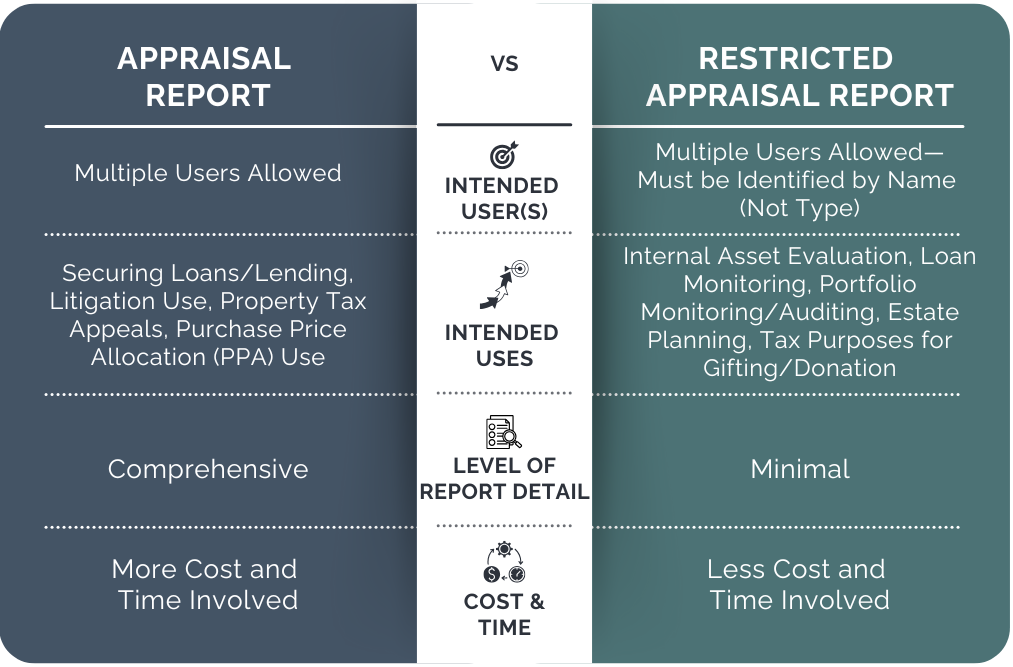
The standard appraisal report is the more common format and is typically used in lending for securing mortgages/loans, but the restricted appraisal report can also be appropriate in specific situations. The table below summarizes key elements and characteristics that generally pertain to each report format.
Primary Elements of Appraisal and Restricted Appraisal
Source: HVS
As the circumstances behind every scenario for an appraisal will vary, it is critical for all parties to discuss the scope of work required at the outset of an engagement, prior to commencement, in order to ensure selection of the appropriate report type. The intended-use examples in the preceding table may not always apply depending on a variety of factors. Additionally, user-specific requirements such as jurisdictional laws, IRS requirements, auditing standards, and other situations can exclude the restricted appraisal as an acceptable format.
Ultimately, since a restricted appraisal report presents limited detail about the property and minimal explanation of appraisal methodology, this format is not suitable for readers who are unfamiliar with the property or basic appraisal methodology.
The appropriate report format for an appraisal is ultimately contingent upon the intended use and intended user(s) of the appraisal. While a restricted appraisal report can serve as a streamlined, cost-effective deliverable, clients should be mindful of the limitations of this report format.
At HVS, we complete thousands of hotel appraisals and other consulting assignments each year. If you are unsure which type of appraisal is most appropriate for your needs, our professionals can guide you. Reach out to Brian Bisema to be connected to the expert who best meets your needs.
About Brian Bisema

Brian Bisema is a Managing Director and Partner with HVS Boston. Brian brings over 15 years of hotel expertise, delivering appraisals, valuations, and consulting services that provide clients with credible results to make confident investment decisions. He has completed hotel valuations and appraisals on hotel real estate with an aggregate value of over $20 billion. For more information, contact Brian at +1 (781) 454-8930 or bbisema@hvs.com.
Restricted Appraisal Vs. Standard Appraisal: Understanding the Differences – By Brian Bisema – Image Credit Unsplash+
USPAP outlines two appraisal report formats: restricted and standard. The key difference lies in detail—restricted reports are concise, while standard reports offer thorough explanations. Choosing the right format depends on several factors, and an appraisal expert can help you choose the right format for your needs.
Per the Uniform Standards of Professional Appraisal Practice (USPAP), there are two appraisal report formats: the restricted appraisal report and the standard appraisal report. But what’s the difference between these two report types, and how do you choose the right type for you?
While the level of due diligence and analysis in preparing the valuation is the same for both formats, the primary difference is the level of detail and supporting data presented within the report.
A restricted appraisal report serves as a concise deliverable that states facts and findings with minimal explanation and details; this abbreviated report format may or may not be appropriate and sufficient depending on the intended use and intended user(s) of the appraisal.
In comparison, a standard appraisal report, also known as simply an “appraisal report,” provides a much greater level of support and detail so that the user can better understand the appraisal’s facts, findings, and results.
The standard appraisal report is the more common format and is typically used in lending for securing mortgages/loans, but the restricted appraisal report can also be appropriate in specific situations. The table below summarizes key elements and characteristics that generally pertain to each report format.
Primary Elements of Appraisal and Restricted Appraisal
Source: HVS
As the circumstances behind every scenario for an appraisal will vary, it is critical for all parties to discuss the scope of work required at the outset of an engagement, prior to commencement, in order to ensure selection of the appropriate report type. The intended-use examples in the preceding table may not always apply depending on a variety of factors. Additionally, user-specific requirements such as jurisdictional laws, IRS requirements, auditing standards, and other situations can exclude the restricted appraisal as an acceptable format.
Ultimately, since a restricted appraisal report presents limited detail about the property and minimal explanation of appraisal methodology, this format is not suitable for readers who are unfamiliar with the property or basic appraisal methodology.
The appropriate report format for an appraisal is ultimately contingent upon the intended use and intended user(s) of the appraisal. While a restricted appraisal report can serve as a streamlined, cost-effective deliverable, clients should be mindful of the limitations of this report format.
At HVS, we complete thousands of hotel appraisals and other consulting assignments each year. If you are unsure which type of appraisal is most appropriate for your needs, our professionals can guide you. Reach out to Brian Bisema to be connected to the expert who best meets your needs.
About Brian Bisema
Brian Bisema is a Managing Director and Partner with HVS Boston. Brian brings over 15 years of hotel expertise, delivering appraisals, valuations, and consulting services that provide clients with credible results to make confident investment decisions. He has completed hotel valuations and appraisals on hotel real estate with an aggregate value of over $20 billion. For more information, contact Brian at +1 (781) 454-8930 or bbisema@hvs.com.